Peacock Garn
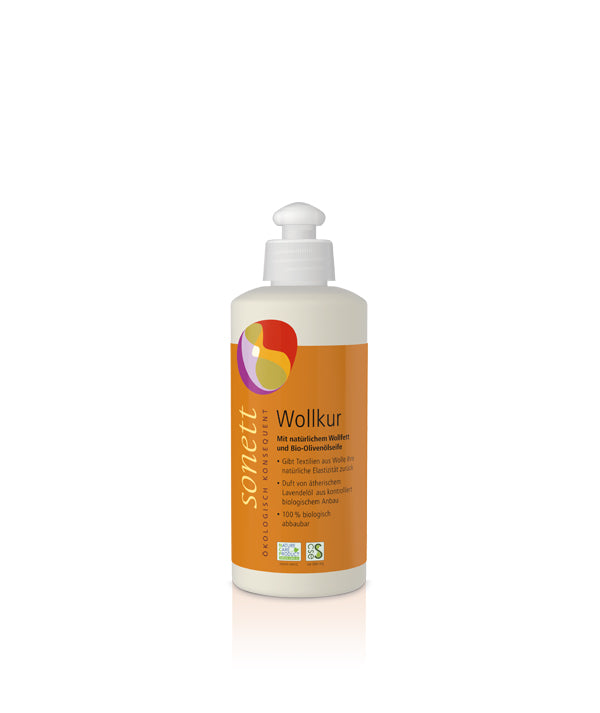
Sonett Wool Conditioner 300ml
Sonett Wool Conditioner 300ml
Couldn't load pickup availability
With natural wool fat
and organic olive oil soap
- For re-greasing heavily used
wool and silk clothing - Restores the natural
elasticity of wool textiles - Scent of essential lavender oil from
controlled organic cultivation - 100% biodegradable
Available in:
300 ml (DE5020)
Ingredients
Product Declaration
Natural wool fat (pesticide-free) 15–30%
Olive soap, from controlled organic cultivation 15–30%
Sugar surfactant 5–15%
Cetyl alcohol 1–5%
Vegetable thickener <1%
Citrate <1%
Essential lavender oil, from controlled organic cultivation <1%
Balsamic additives, from controlled organic cultivation / wild collection <1%
Water ad 100%
Ingredient list according to EC 648/2004
Aqua, Lanolin, Potassium Soap*, Alkylpolyglucoside
C8–C16 (Coco Glucoside), Cetyl Alcohol, Polysaccharide (Xanthan Gum), Sodium / Potassium Citrate, Parfum*, Linalool*
*certified organically grown
Origin and properties of ingredients
Wool fat is obtained from freshly shorn sheep's wool and freed from pesticide and herbicide residues through a special process. For the wool fat to disperse finely in water and absorb into the fiber, it must be emulsified into fine droplets with the help of olive soap and sugar surfactant. Sugar, coconut and palm fat are the starting materials for the production of sugar surfactant. Olive soap is formed by the reaction of olive oil with lye. Olive oil is the best oil raw material for a mild, re-greasing vegetable soap. Its balanced fatty acid composition, its healing, balancing effect on the heart and circulatory system, and the remarkable 7-year growth cycle of the olive tree plant demonstrate the special closeness and relationship of this oil to humans. Cetyl alcohol derived from palm fat and vegetable thickener support the emulsifying effect of sugar surfactant and olive oil soap.
Technical Data
Density: (20 °C) approx. 0.99 g / cm³
pH value: (20 °C, 5 g / l H₂O) approx. 7–8
Contains lavandin oil. May cause allergic reactions.
Store preferably between 10 and 25 °C.
Keep out of reach of children.
Application
Product specialty
The wool fat used is of pharmaceutical quality. With the help of olive oil soap and sugar surfactant, the wool treatment can be used without problems even with hard water. The olive oil and essential lavender oil are 100% from controlled organic cultivation.
Area of application
For re-greasing heavily used wool clothing and wool nappy covers.
Application
For re-greasing heavily used wool and silk clothing.
Particularly important for wool nappy covers, which, due to their natural wool fat content, absorb the wetness of the nappy pack and yet are air-permeable. When wool nappy covers are washed, they lose the naturally present wool fat. Regular use of the wool treatment restores the wool fat necessary for their function to the wool.
Dosage for wool nappy covers
Dissolve 1–2 tablespoons of wool treatment in some hot water and fill up to approx. 1 liter with cold water. Place the damp wool nappy cover in the hand-warm solution, press it through several times and leave it in for approx. ½–1 hour. Rinse in lukewarm water, squeeze out and let dry on a towel.
Dosage for heavily used wool clothing such as felted jackets, wool felt hats, work sweaters, etc.
Dissolve ½ teaspoon of wool treatment in some hot water and proceed as described above.
The wool treatment can also be used in the washing machine. To do this, dissolve ½ teaspoon of wool treatment in approx. 30–40 ml of warm water and pour the solution into the fabric softener compartment of the washing machine.
Ecology
Biodegradation
The natural substances wool fat and cetyl alcohol, in finely emulsified form, are easily biodegradable. Soap made from vegetable oils has the outstanding peculiarity compared to all other washing-active substances that it immediately combines with the lime always present in wastewater to form lime soap, thereby neutralizing its effect on living organisms (primary degradation). The lime soap is then 100% degraded by microorganisms into carbon dioxide and water (secondary degradation). In the production process of sugar surfactant, parts are taken from the plant raw materials starch, sugar and fat, but their chemical structure remains fully intact. Therefore, it is easy for microorganisms to break down these surfactants 100% into CO₂ and H₂O very quickly and completely. Soap, sugar surfactant and cetyl alcohol are considered easily biodegradable according to OECD.
Eco-certification
CSE (Certified Sustainable Economics)
Packaging
Bottle: PE
Closure: PE / PP
Labels: PE
Outer carton: 100% recycled material
Manufacturer:
Sonett GmbH
Mistelweg 1
88693 Deggenhausen
Germany
Phone: +49 (0)7555 92 95-0
E-mail: shop@sonett.eu
Share